

Finding Peace
People I didn't even know well took me in their arms

“Now you will truly be an orphan,” the therapist said. “Not just emotionally. A real orphan because your father just died and now your mother’s dying, and you will cast off your family.”
Why cast off my family? Weren’t my siblings orphaned as well? Didn’t I owe my family allegiance for life?
As if searching for self-inflicted burns, the silver-haired seer tilted her head. “As you’ve done all your life, you can try to rescue everyone. Or you can begin to care for yourself.”
After decades without drinking and smoking, I wanted to drink and smoke. I’ve never done heroin, but that sounded fine, too.
Really, though, I just wanted the idea of smoking. My twenty most reliable friends, as someone once called them.
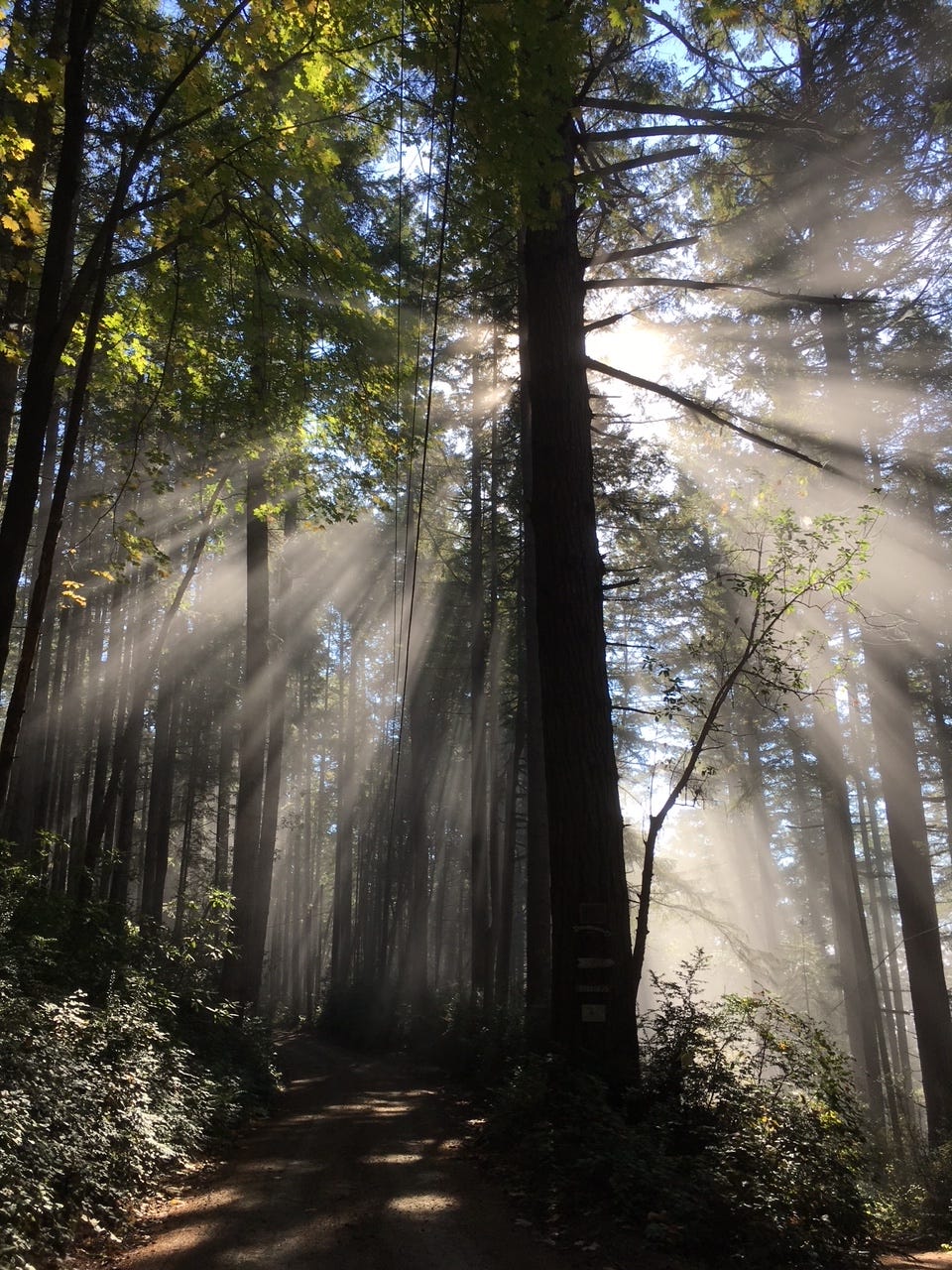
Instead, as always, my drug of choice was long walks. I walked so fast my collie and golden retriever couldn’t keep up. I walked until I reached an altered state, until the morning light hit a forest-fire singed blue-black stump at the same moment a Pileated woodpecker called overhead. I walked so much that my toenails turned the color of blood, like a marathon runner.
Dad died first, and my mother exactly one year later. During that year, I attended a free weekly support group run by a professional therapist. I sank into metal chairs and shared secrets with strangers. In that room, I was able to fully live in grief with nothing to hide or tidy up.
The witch hazel my mother gave me for some early birthday now reaches to my cabin’s second story window. I was rarely sufficiently grateful for what she offered. Now, as I practice yoga near the window, the winter-blossoming shrub sends out tiny star-like blossoms. I remember the moment my then-young mother and I were in Port Townsend, and she saw the plant in its black pot outside a store. I hear her voice.
“Would you like that for your birthday?” Then she leaned over and hoisted the pot to her hip.
“Thank you, Mom,” I say now, attached to her by savasana’s slender thread as I float away from time.
That year of Mother’s dying, I was often unable to sleep. If through sheer exhaustion I managed to sink briefly, I jolted back awake. I was too aware of Mother alone in her cell-like hospice room after her lifetime teaching students how to see, and how to write what they saw. I felt as if a screen separated me from others. I dreaded visiting Mother and then felt guilty for my dread. Grief was a heavy fist, a massive weight pressing on my chest.
As I lay awake, heart pounding, Mark would wrap himself around me, enfolding me, a womb, and at last I could slip away.
Sometimes I awakened with renewed energy to act, to quit feeling sorry for myself. I wanted to bypass feeling, take the scenic route, as Mother always called it, to arrive somewhere else. I wanted to accept death as a natural and even healthy part of life, as beautiful, a way of prayer, a cessation of heartbeat and breath. As the therapist said, though, parental death is primal; in the wild, a child without parents is doomed.
I’ve read countless books about death and dying. I need to help my friends, I told myself. I was the strong one, the helper always ready to sit with those in need.
The therapist told us that whatever we felt was okay. The bereaved often feel numb, she said. Some are irritable. Life might seem unreal, and out of the blue, for no apparent reason, we might feel frightened. It was normal to feel as if I was going insane. To experience odd physical sensations such as that my heart might fly right out of my chest.
The morning of Mother’s memorial, I felt as if I was turned inside out. I’d lost so much weight I had to tie a belt around my skirt to hold it up. After the service at Belfair’s Anglican church, which my mother attended every Sunday, I asked Mark to drive me to the Port Townsend support group two hours away.
If we left right away, I’d make it.
When I told the group I’d become hysterical, the therapist said, “Hysteria is deep healing.”
“What if I can’t come back?” I asked.
“You will come back,” she said.
After their child’s, partner’s, parent’s, or friend’s death, some in the support groups rarely left their homes. Most of us lost weight, and some became almost skeletal. Some described the death in detail. Others mentioned regrets and guilt: “She wanted a scarf. I pushed her wheelchair on past.”
Most preferred to keep the person’s clothes or shoes. Some slept in an article of clothing that had belonged to a loved one. “I don’t have the energy to make decisions,” most said, while others yearned to flee, as if by changing their location they might shake off their pain.
Our first task, the therapist told us, was to learn to say no. As a child, to say no might mean being punished. Don’t punish yourselves, she said. Don’t rush your grief. Don’t take on new responsibilities if you can help it.
Despite the intimacy of what we shared, in the Port Townsend group, hugging was never the norm. We returned to our homes like snails into shells. In contrast, in New York, when I staggered into my support group the day my father died, people I didn’t even know well took me in their arms and held me in the deepest way, as if our hearts could touch.